Category Archives: Stretching

When & Why You May Be Overdoing Unknowingly?

Standard

Life Is Not Meant to Be So Hard When You know What Drives You!

Instead, it becomes efficiently productive on and off the mat. You can enjoy any kind of yoga you like even power yoga, yet you are safe from promoting injuries and you get the best out of your practice.
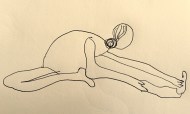

Overstretched back and compressed neck

Overdoing can be easy to change when it is not intertwined with cultural and emotional attachments to doing things the hard way. And when intertwined, this underlying motivation interferes with your best practice of yoga and your general well-being on and off the mat.

That is why overdoing is not as clear-cut as it sounds!

1) You may choose to overdo because you see it as pushing your limits in a good way. When practicing yoga, you may even consider pain something to ignore to build mental strength and to better your practice. This way of practicing and teaching comes from an old interpretation of the yoga teachings that have come to you from teachers who learned from teachers who jived with extreme asceticism. However, many new and experienced teachers are totally letting go of this approach to yoga, others are in the process of letting it go. Buddha himself had to overcome that way of thinking before he could get to enlightenment. Where are you at on that journey?

2) You may strain without wanting to but you do not know how to not strain in a given pose. That often comes from the way poses are still currently cued to you in your yoga classes or yoga books. Any encouragement to willfully “engage” specific muscles or body parts is overdoing because it is interfering with the natural movement design of your whole-body. Instead, learn to let your whole-body intelligence handle the muscle engagement of your whole-body for you within each pose or movement you chose to do. And till you learn, stay present to your whole-body whatever the pose you are in, it can help already. Nature works as a whole, not in parts.

3) You may strain your body without even being aware that you are doing so due to “unconscious habits” you have brought from your daily life onto the mat. The thing is that your mind may have pre-conceived ideas around what it means to “lengthen the spine” for instance. Mainly, your habitual way has come to feel more natural than the natural way. So as you are straining,  it “feels right” to your habit even though it may not be natural or beneficial for your body at all.

And these 3 ways of overdoing are often combined or overlapping in various ways.


Over-arched back and over-tensing of the quads.

Most likely, excess tension brought you to your first yoga class. And am with you, it does feel good in the moment to stretch the tension with various yoga poses. Or it feels good to strain some if you associate straining with positive effort to gain strength.


Overstretched back, locked hip joints sockets, over-tensed calves and compressed neck!

The truth is that if you are straining, you are not letting your postural mechanism do its job. And it is designed to handle your best balance, coordination and posture with no strain and with vitality.  Instead, you may compensate for it by creating unnecessary muscle tension or by overstretching your muscles to the point you meddle with your muscle tone just because it “feels good” in the moment.

When you learn to let your whole-body intelligence be in the driver seat, you can regain accurate perception of your “feelings” and your yoga practice can be most efficient without straining. How do you do that?

The Body Intelligence Activation Process activates your postural mechanism so you receive reliable guidance from your whole-body intelligence 24/7. Each time you consciously activate it, and progressively more so over time, your feelings become increasingly reliable again, your balance, coordination and posture improve organically in the process. Anyone can do this and you can too!

Want to explore this further and learn more about this amazing natural skill that can be regained? Read more of the posts on this blog-site, sign up to my free email seminar or join my free live interactive webinar series which will be offered a few more times before I start my 90 Day Live Interactive Program in May.

1) Free Email Seminar 2) Free Webinar 3)  90 Day B.I.A. Process Program.

Cecile Raynor has been teaching the Alexander Technique for over 25 years out of which came her B.I.A. Process to assist yogis enhance their practice bypassing the intellect. She is also a Thai Yoga Massage Therapist and a Reiki Practitioner. Faculty at Akasha Yoga Teacher Training, she runs a 12 months Mastermind for Yoga Teachers with a Vision, and a 90 Day Virtual Program for trainees, new teachers and committed yoga practitioners interested in using their body more efficiently on and off the mat. She is currently writing a book on her personal and professional experience to be published this year with BlissLife Press, San Diego California.
When Is It Not Good To Perform Toe Standing Poses?

Standard

You may have been told that Toe Stand Poses strengthen your abdominal muscles, hips, knees, ankles, and toes. Have you actually experience that without straining?
Going on your toes in Downward Dog or other poses using both feet equally can be fine, even helpful sometimes. However, poses on toes with a high level of imbalance is unlikely to be done by the average person without promoting injuries down the line.

When in a class using lots of these poses, I could not help but noticing in other yogis body distortions and compensations. Those, I knew, were causing muscles and joints straining which promotes body stiffness.

It is not because your yoga teacher can do a pose that the pose is good for your own body. Nor does it mean that staying in a straining pose is how you get better at it, it is how you get injured.

Staying in a pose using a tool to activate your whole-body guidance and get its 100% approval is how you prevent injuries and get the most out of your practice.

The first principle of yoga is “Ahimsa”, do not harm anyone. That includes yourself! And despite the widespread belief that strain is good for you, it is not so, this is only a “belief” that is getting outdated!

Strain may indicate that you are bringing unconscious habits of movements from your daily life to the mat. It is also the first step of injuries to come.

The Body Intelligence Activation Process or B.I.A. Process is an awesome solution to these challenges.

If you want to learn more about how to activate your whole-body intelligence on demand so you can prevent injuries on and off the mat and get the most out of your practice?

Join my latest FREE 6-part EMAIL SEMINAR:

“How to Unlearn Habits that Create Body Stiffness On and Off the Mat”
Based on the Alexander Technique & The Body Intelligence Activation Process
(B.I.A. Process)
To sign up to my local or online offerings click at the top of this homepage

Stretching the Same Tension Over & Over?

Standard

There is a reason for that and it may not be what you think!

Image may contain: drawing

You may be stretching for flexibility and doing strengthening exercises for strength, yet does this keep you tension free on or of the mat? Or the same tension seems to come back endlessly?

Focusing on stretching and strengthening as two separate qualities is doing just that, focusing on “Separateness”! Learning to focus on these two qualities as the two sides of the same coin is the way to focus on “Unity” and its benefits which is to keep you tension free on or off the mat as you keep getting strong and flexible.

How can you do this when you think that mostly your muscles are your main pathway to strength and flexibility? How can you attend to both at the same time and know how to assess how much of which you need?

Maybe your true strength is not coming from your muscles as much as your skeletal structure and your mind working with your whole-body intelligence? Maybe your joints and muscles are more of a pathway to your flexibility as they keep everything together? And maybe, learning to release your joints is more key to your flexibility?

Releasing excess tension is neither going limp
nor decreasing how much strength you are building.
It is preventing building body stiffness while you are building strength!

In fact, if your bones were suddenly melting, no matter how strong your muscles, would you not turn into a puddle?

Flexible-strength as a skill where both strength and flexibility can be nurtured simultaneously is my personal and professional experience of what Patanjali recommends in his Sutras, namely that each yoga pose be practiced with “Steadiness & Ease”!

When you understand your body functioning in that way, you can build up muscle strength without building excess tension at the same time. When you learn to activate your postural mechanism, you can release excess tension while in a strengthening pose, as you build flexible-strength, prevent injury and reach your highest best without side effect like stiffness in your joints and muscles.

Interested in this way of thinking your movements and poses? Want to learn how to activate your whole-body intelligence via your postural mechanism, opt in my live offerings, local or online.

1) Free Email Seminar 2) Free Webinar 3)  90 Day Virtual & Interactive

Self-Consciousness, Self- Awareness & Straining!

Standard

Do you know what really motivates you to exercise deep down?

IMG_4925

On the surface, it is easy to assume that you do it because exercise is good for you as doctors and scientists keep telling us. Could it be that it is not all that black and white? Not that I am discouraging you from exercising at all. You’ll always gain some benefits from exercising, but do you always get only benefits? And do you get the best out of your practice regardless of how or why you do it?

When I used to exercise out of being self-conscious about my weight or the way I looked, I was totally overdoing it. I was exercising with all the uptight energy coming from efforting to control my body, shape it, trim it, make it thinner. And although exercising was still beneficial to me in some ways, the problem was that it was motivated by a sense that I was not good enough, I was not lovable or attractive enough as I was and would not be till I reach this unrealistic ideal (for most of us) imposed by the media to all of us, especially women.

IMG_4923

Why is it a problem? It is a problem because when the underground reason for exercising is fear-based self-consciousness, you are actually stressing the body in a way that stems from and activates your “reptilian brain”. This results in the production of a stress hormone called Cortisol which affects both your mind and body into protective mode favoring holding and contraction. This tends to keep you in the fear based cycle of not feeling good enough unless you are pushing yourself. Exercise becomes an addiction of sorts. How do you truly feel when you reach your goal, do you appreciate it and relax or are you driven to keep going like the hamster on his wheel? Does this sound like a familiar cycle? You are definitely getting some good benefits from the physicality of yoga, but is it worth it to not examine the real reason motivating you to practice when it can actually strengthen your underground stress level in the process? Not to mention that this is what promote straining on and off the mat.

When practicing yoga is really love-based, you are truly nurturing your body in a way that stems from and activates the “pre-frontal cortex”. It creates a feel-good hormone called oxytocin or the “love hormone” which affects both your mind and body into open-mindedness and expansion. It also allows you to function as a fluid coordinated self. This develops flexible strength as one skill instead of focusing on stretching, strengthening or posture organizing as if they were separate from each other. The more you approach movements as a coordinated self, the more your body handles the perfect adjustments necessary for any chosen activity. Your Whole Body Intelligence knows how much to stretch this muscle, or strengthen that muscle and realign your postural balance for you all at once. Straining becomes unnecessary.

IMG_4930 IMG_4929

And in this process, your synergy changes to be more functional without needing to strain or push yourself in the usual sense of the term. You challenge yourself by choosing and staying in a specific pose or activity yet you let go of the strain so your body can step up to the plate and do its magic! The idea is to let your body do its job and trust its innate intelligence. It knows better than your mind and the results are safer.

I once was totally off balance for months. As I got out of my overthinking mind to observe my every movements , I was able to discover and then let go of habitual patterns that were straining my body. While letting go, I was also rebooting my whole body synergy using my Body Intelligence Activation Process (B.I.A. Process), a way to allow the natural way to take over. As a result, my own body reorganized my very twisted posture into perfect balance in a month time when constant visits to chiropractors, acupuncturists and massage therapists had not given any sustainable results for a period of 6 months.

IMG_4924

Acting on and off the mat from a place of “Self-Consciousness” is not serving you because it is rooted in a feeling of inadequacy that you feel you must overcome,  product of your intellect judging your self as not good enough.  I know because I have been there and it is easy to revisit that familiar place when we are not in the now. Instead let’s be rooted in the present moment, accepting of what is. Acting from a place of “Self-Awareness” outside the intellect is the way to blossom into whatever you choose to do on or off the mat.

And learning to activate the Intelligence of your Whole Body is an awesome key to letting go of  self-consciousness and embrace self-awareness, it is a process that allows your mind and your whole-body wisdom to be team partners, living in the same time zone in a way that gives you optimal safety and best performance whether you are on the mat or in daily life. It positively affects your level of self confidence and  self appreciation while you get the most out of your yoga and out of life.

Interested in exploring this further? Then check:

1) My Free Email Seminar 2) My Free Webinar 3) My Pilot 90 Day E-Course Special.

Physicality, Embodiment & Yoga

Standard

Do you feel that unless you strain when you exercise, you are not doing enough?
Are you sure that strain is necessary to get strong in body or mind?

Do you think you are connected to your body because you exercise or practice yoga?
Are you sure that being physical means that you are well connected to your body?

What if strain only added body stiffness to the strength you could build without the strain?
What if being physical was not enough to be fully connected to your innate body wisdom?

IMG_20160203_122745161IMG_20160203_122936107
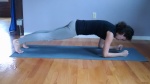
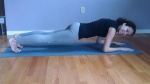
On the left she tightens and creates body stiffness in her outer muscles,
on the right she allows space to relax and let her core muscles strengthen themselves!
My  journey from physicality to awareness of disembodiment

When I started exercising and decided to eat right, I was motivated by wanting to look the best I could and keep my weight down. I used to exercise 3 hours a day. Half of that time was walking to and from campus for 45 minutes each way and the other 90 minutes were at the gym, running or an aerobic dance class plus using the universal machines of the time.

I thought I was very connected to my body and although I never strained to the point of hurting myself, I did judge the amount of appropriate tension by how much I was pushing myself. Burning calories was high on my list as I have a compact muscular body and always wanted to trim it down.

However, I had a profound realization that changed the course of my life. One day, while finishing grad school and being very pregnant with my first child. I found myself leaning on the table at the library so my belly was totally squished against the edge of the table. Noticing that was like a wake up call. I asked myself ” What am I doing to my baby? And what am I doing to my body?”. I started noticing other such instances. Maybe I was not as connected to my body as I thought? It made me realize that physicality was only part of being fully connected. I became aware that my physicality had been driven by my mind that acted as if it knew better than my body.

My journey towards embodiment of my aware mind
 DSC_0405

That profound realization led me to practice meditation and let go of a promising career teaching French Literature at the college level for which I had just studied several years. Everyone thought I was crazy. But academia was going to keep me in my head so I had to find another more holistic type of teaching, and I did. Although embodiment is a life long evolution, working in a mind/body field with the Alexander Technique has made a huge difference in my life, especially combined with my meditation practice.

Over time, I realized and experienced that my addictive straining was only adding body stiffness to the strength I was building. It was true in the gym or on the yoga mat. I found it to be a mindset that reveals itself throughout all aspect of my life as self-created stress if I let it. And when I am flexible and strong in my mind, I can enjoy flexible strength in my workout or my yoga practice.

It became clear that I wanted flexible strength and that flexible strength starts with an aware and embodied mind. When your mind is embodied, there is no room for strain when you are being physical because you are in harmony with your innate body wisdom. And this is a whole body affair through every movement and every moment of the day. When you focus mainly on physicality, you are missing a dimension and the door to injury is still wide open whether you are at your computer, in your kitchen or on the mat.

When your mind is embodied, there is no room for strain when being physical
because you are in harmony with your innate body wisdom.
IMG_2643

Connecting to your body in a holistic way means that you are not tending separately to the mind and the body. You are aware of both whether you meditate or exercise. It also means that you allow your whole body wisdom to guide you as it is designed rather than controlling your skeleton muscularly according to the dictates of your mind as if it knew better than your innate body intelligence. It means organic good posture takes care of itself in a sustainable way like it does in children.

There is a breakthrough process that can help you access your whole body wisdom with ease whatever type of exercise you enjoy doing. It helps you to be embodied in a way beyond focusing on your stretch edge or your pain edge which represents only a small percentage of your whole body wisdom. It helps you reclaim organic good posture and strain-free living.

Interested in exploring this further? Then check:

1) My Free Email Seminar 2) My Free Webinar 3) My Beta 90 Day E-Course Special.


The Art of Flexible Strength: Drop the Strain, Keep the Strength!

Standard

IMG_4020
Striving to Stretch

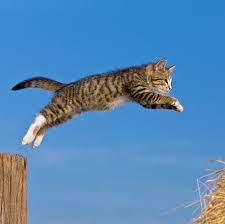
As a yogi or fitness practitioner, do you  feel it is important to develop strength and flexibility? And yet do you truly feel you are developing flexible strength in the process? The flexible strength of the cat for instance which allows the cat to be totally tension free one minute and in an instant, display amazing strength, flexibility, accuracy of aim and speed of action.

If you are like most of us, the answer is no, not really!

IMG_4021
Beautiful natural integrated stretch

The truth is you strive for more flexibility and you may succeed up to a certain point. Yet are you tension free between yoga classes or even on the mat? If you can say yes, then you can stop reading right here. If the answer is no, then read on.

One reason you may not feel as flexible as you would want to be in your body (even though you work hard at it), is because flexibility starts in the mind, it is not just a body feature. And since the mind and the body are the two sides of the same coin, if your mind is not flexible, your body will reflect that by feeling uptight and it goes the other way round as well if you are flexible as a whole rather than having some flexible parts.

DSCN8391 DSCN8402 DSCN8394
Different bodies and awareness levels, different practices, different level of benefits

Another reason is that you may have unconscious habits of movements that are in the way of getting the result you are working for. I have found this to be a common explanation for nagging muscular and joint tension. In fact there are five such common habits that stem from misconceptions of movement. They have to do with you using parts of your body to do the job of other parts of your body so naturally, the misused parts end up complaining that they are not suited for the task. Becoming aware of this in your own body is a game changer.

The young man in the picture is aware of the way the pose is supposed to be but some of his unconscious habitual patterns prevent him from doing the pose the way he sees it and if he tries to straighten his back muscularly, he can only strain. Luckily he sensed that and was not trying to force anything. And the habits could manifest more subtly and be harder to detect but still doing a job on the synergy of your body. The fact is these common unconscious habits make you use your body in a way that is not in line with your innate body wisdom. As a result, no matter how much exercise you do, you feel you are not getting the results you want or when you do, you find them not to be sustainable.

One way to address this is to attend my free webinars or better yet sign up for my 90 Day Live Interactive E-Course. The work I do is very practical and can benefit you from the start by expanding your awareness with a new way to approach movement. It can also help you handle mind or body stress from a fresh new perspective and truly transform your life.

For more info or to sign up to June 9 webinar, go to: https://offthematyoga.leadpages.co/free-live-interactive-webinar/
For the E-Course, go to: https://offthematyoga.leadpages.co/cecileclearofferinteractivee-course/


The Secret to Ultimate Safety and High Performance on the Yoga Mat!

Standard

IMG_3910
“Striving Yogis” by Cecile Raynor

Since 2012 when the New York Times published an article called “Can Yoga Wreck Your Body?”  followed by a Huffpost interview with Glenn Black,  many yoga studios and teachers everywhere have been innovating to increase safety on the mat. Teachers have been learning how to assist yoga students. Practitioners at risk have chosen gentle forms of yoga, while many others shy away from yoga all together.

In the meantime, yoga studios are filled with a big majority of young yogis with forgiving bodies who still handle a lot of strain. For them, “no gain without pain” has been replaced by “no gain without strain”. Pushing to their limit just because they can (whether stretching or strengthening) is seen as a good thing. So they follow their teachers guidance and are satisfied to push and pull to their heart’s content as long as it feels good and they pay attention to not reach their pain threshold.

NO GAIN WITHOUT PAIN has become NO GAIN WITHOUT STRAIN

But is that enough for ultimate safety on the mat and is it even the best way to reach highest performance? Are yoga studios safer than before? Is yoga practice enough to keep yogis bodies strain-free and their minds able to manage stress gracefully between classes? How is it for you? Which part of your yoga practice is sustainable in your daily life and which is not? We all know yoga is not what wrecks people’s body, so why do many people still get hurt on and off the mat even when they exercise in the gym or on the mat?

For one thing,  some of the assisting has been questioned to the point that some studios have created special tokens or cards used on mats to signal teachers whether they are welcome to assist or not.  True, some yoga assists have turned into well received massage moments although some yoga students simply do not care to be touched and always want the option to say so; mostly, students asking for tokens have gotten hurt by teachers assisting hands. Why is this happening?

IMG_3906

There are 3 main reasons for this happening.  Despite the numerous assist workshops given out there, the first reason is a lack in quality touch experience in teachers as well as a lack of awareness of the mind-body foundation of all movements. These happen to be strengths of Alexander Technique teachers who have a 3 year training of 1600 hours before they get certified. Yoga teachers start teaching after 200 hours of certification with little training if any in these two aspects. Secondly, there is the way teachings were passed on through generations of teachers suffering from loss and misinterpretations which led to some asanas created only in the past century to be widely embraced even when not necessarily appropriate for everyone nor always in line with our innate body intelligence.

Last but not least, since the Industrial Revolution of the 19th century, men have been focusing on appearances, money and machines. We have come to think of the body as a machine with parts to exercise and replace when necessary. For all the buzz on holistic health, the norm remains to focus on body part exercising across the fitness world. Do you catch yourself chronically holding your back trying to sit or stand upright to slouch only seconds later? Could it be happening because it is neither comfortable nor natural to being up that way?

IMG_3752
Organic good posture, no conscious efforting involved!

Many are disconnected from their “whole body” wisdom as they are exercising their “body parts”. Do you go to yoga to improve your posture, strengthen and stretch? Yet do you still experience neck or back tension, or strained knees on or off the mat? As it were, there are more gadgets than ever on the market to address “bad posture” and its consequences: neck, back, shoulder or joint discomfort or pain. However, are they only band-aid solutions or do they produce sustainable results?

Much of the teachings on posture tend to equate alignment with good posture which results in a static expression of aligned posture.  Like posture gadgets, they also imply that muscularly correcting posture is the ultimate solution. The reality is that there is more  to good posture than alignment. “Good Posture” is a dynamic and organic happening like in children!

Learning to activate your postural mechanism is the secret breakthrough skill that can lead you to improved posture with no neck, back or joint straining on or off the mat. It is a reflex-like system we are born with that is activated when we step out of our own way to let our body intelligence do its job. And every time we release excess tension without sacrificing our skeletal height, it gets activated. You probably stumbled unto it before when you suddenly reached your effortless balancing spot. Only it is a skill you can learn and access on demand based on undoing conscious and unconscious habits of movements. When under your belt, that skill allows you to approach every yoga poses from a totally different angle where straining is not necessary to strengthen or stretch with ultimate safety and to reach your highest performance!

FREE LIVE EVENT:  BREAKTHROUGH SKILL
 << Not taught in Yoga Trainings >>
 March 16, 2016 @ 7.30pm EST
 

It is to bring you an experience of this breakthrough skill that I have been learning about webinar and e-course technology. I am now happy and excited to invite you to my first webinar offering and I will personally introduce you to this breakthrough skill which can help you open the door to ultimate safety even within high performance level! You will be given a chance to engage in some experiential activities and I am scheduling time for Q & A as well. I will also explain how this skill can lead you beyond band-aid solutions, to sustainable results.

Why mark your calendars and sign up asap? It is a global offer to yoga practitioners and teachers in the world, yet I am only offering 50 spots. Participants will be accepted on a first come basis.  At the end of the webinar, participants will be given a chance to sign up for my 90 Day Interactive E-course First Launch at 50% off which includes loads of bonuses as well. Available only to 25 people!

So here is the link to sign up to the Free Webinar: https://offthematyoga.leadpages.co/free-webinar-breakthrough-skill/

Hope to meet some of you in cyberspace!

Cecile Raynor
Alexander Technique Teacher, Thai Yoga Therapist & Kryia Yoga Initiate

The Top 5 Myths about “Good Posture” On & Off the Mat – Debunked!

Standard

images-5

 MYTH #1: Good Posture means Chest Out and Shoulders Back

Reality: Good posture is not about getting it right, it is not about positioning your shoulders. This way of approaching posture creates back muscle tension and is not sustainable. In a daily context, by pushing your chest out and pulling your shoulders back, you soon find yourself slouching right back to where you started (unless you are a “chronic holder” which does not serve you either). Good posture is a dynamic and integral part of fluid functioning, not a deliberate holding in place. Look at young children! No effort whatsoever. It is your birthright!

Solution: Instead of letting your mind manipulate your skeleton by engaging your muscles, learn about integrated body use so you can let your innate body wisdom handle your posture for you. You are using your body in an integrated way when all body parts are working in harmony together guided by your innate body intelligence. As a result, you experience your skeletal system strength instead of using unnecessary muscle tension.

images-16
Effortless Good Posture

MYTH #2: Exercising Core Muscles promotes Good Posture

Reality: Yes, core muscles are crucial for good posture. Only they are not the muscles you may think. Just like an apple core is the center part of the apple, core muscles are also located deep in your center. Inner muscles and outer muscles must work in harmony but they cannot all be equally engaged at once. When you engage your outer muscles to feel strong, you are automatically disengaging  your core muscles.

Solution: When you challenge your body in whatever position or exercise you chose to; give your core muscles a chance to step up to the plate and strengthen by not tightening your outer muscles. For instance, if you are doing a plank, you stay in your plank all the same. The challenge of it remains, only disengaging the outer muscles allows the core muscles to kick in. The secret here is to keep your skeletal alignment. Then, listen to your whole body. Do not expect the inner muscle work to feel like the outer muscles when engaged. Inner core muscles work deeper, quieter and are felt more as a whole body experience.

images-7
Her open hands, smile, and her open upper back suggest she is building Flexible Strength rather than Body Stiffness!
This also means she is allowing her Core Muscles to step up to the plate and strengthen!
She is cooperating with her Whole Body Wisdom.

plank-exercises-variations
Her uptight upper back and neck, her held facial expression and tight fists are clearly signs
she is building Stiff Strength in her Outer Muscles & not allowing her Core Muscles to step up to the plate and strengthen!
She is not cooperating with her Whole Body Wisdom.

MYTH #3: Stretching & Strengthening Back Muscles promotes Good Posture

Reality: Stretching and strengthening the back as it is commonly done is working the big outer muscles of the back, the ones you can feel being stretched and exerting effort to strengthen. It may feel good when you do it but “feeling good” and “being good for you” are two different things although they can happen together when in line with your whole body wisdom.

Solution: Discover your postural muscles for effortless and sustainable good posture. These core muscles get increasingly stronger when you let them do their job of supporting you instead of you engaging the big outer muscles to do the job. It is all about developing trust in the wisdom of your body. You don’t need to work so hard like in the plank example given earlier. Work smarter instead by choosing to experience what flexible strength feels like. The fact is that you are still building the same amount of strength. And that is the strength of the cat, not an ounce of stiffness in their body, but they are quite strong when they need to jump or pounce on a moving target.

images-8
Power, Accuracy, Grace…. Flexible Strength at work!

MYTH #4: Good Posture is all about Proper Alignment

Reality: The truth is that there is more to good posture than proper alignment. If you are holding yourself in what you think is the right alignment, you are doing just that, “holding yourself”. And the way you are holding yourself is with excess tension. Besides, you are forcefully going again the synergy of your own body so either it is not sustainable or you are building chronic tension.

Solution: Exploring how much holding you are actually doing would be a first step. Then, choose to no longer hold your skeleton with tensed muscles. Connect with your skeletal system, keep its height, and discover its own strength. That will change the synergy of your whole body so you can experience what it is to be bone tall with relaxed muscles!

images-16images-13
Her arched back and belly forward suggest holding tension in her back.

His perfect alignment without back arching or shoulders pulled back suggest a released yet dynamic posture.

MYTH #5: Gravity challenges Good Posture

Reality: Not so. Gravity promotes good postural balance when you use yourself as you are designed to. When you lose your skeletal height, you are not balanced above your support efficiently. As a result, gravity claims the heavy weight of the unsupported head forward and down. It also brings the shoulders with it whether you are sitting, standing or walking.

Solution: By learning to be balanced above your support, the need to push up disappears without being replaced by the urge to slouch. Allow your weight to be evenly spread on your feet when standing and learn to find the balancing point of your sit bones when sitting, and voila, anti-gravity action works for you instead of against you, propelling you upwards effortlessly like children do all the time!

images-9
When not aligned above support and relaxed, gravity promotes slouching.
When aligned above support and relaxed
, gravity promotes effortless good posture.

Do you want to learn more about this mind/body approach to natural good posture? 
Do you want to learn how to reclaim efficient moving for balanced living?
Join my latest FREE 6-part EMAIL SEMINAR:
"How to Unlearn Habits that Create Body Stiffness On and Off the Mat"
(Based on the Alexander Technique Principles and Facts)

While Pushing your Edge, Building Flexible Strength or Body Stiffness?

Standard

Are you a fitness enthusiast? Do you feel good about your practice only if you push yourself to the max and feel your muscles straining a bit? Maybe you feel you do not do enough if you do not feel that stretch or that muscle power working “effort-fully”? Is that  feeling of muscular tension what you consider “pushing your edge”?

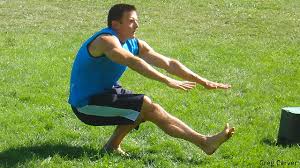
When do you know that enough is enough? What do you think of the fitness enthusiasts below displaying their ability to squat with pride because they feel that edge big time?

images-12

The man, back and shoulders rounding forward to not fall backwards, is overstretching his back and compressing the back of his neck as he is pushing his edge to stand on one foot while squatting. The woman has the ball of her feet partly off the ground because her weight mainly situated over her heels is not evenly distributed above her whole two feet. It means that to not fall backwards, she is compensating by overdoing in her leg muscles building unnecessary tension while building up strength.

Both are also stressing ankles, knees and hip joints which are constricted by the excessive muscular tension required in their legs to keep some sort of balance. Is it worth it to push your edge in a way that creates these issues?

images-13

Is there a holistic way to push your edge that allows you to stretch and strengthen all the same yet does not translate into building compressed joints and muscle stiffness on or off the mat?

For starters, think children and tribal cultures! Look at the individuals below. Notice how their head neck and torso relationship works perfectly as their weight is balanced above their well grounded feet: some of their body weight past their toes, some of it behind their heels. A good example of what to be respectful of while you are exercising so you do not hurt yourself while you are trying to be good to yourself.

images-14 images-16 images-10

In many cultures more connected to the natural way to handle daily movements, it is actually common to see men and women of all ages squat with ease or carry heavy loads on their heads gracefully. Since such flexible strength and ease is possible among some humans, it must be accessible to all, including you!

images-18 Natural-Posture-rock-2

In the animal kingdom as well, you see creatures who can display powerful and precise flexible strength without building any excess muscular tension so they are totally relaxed when not in action. If they stretch, it is a whole body happening done usually once.

These examples are all about efficiency and it is precisely that efficiency that allows them to push their edge safely. Excess tension is seductive but misleading. It makes you feel like you are being productive when in fact it decreases your efficiency and creates stiffness that will backfire on you on or off the mat, sooner or later.

images-19 cheetah images-20

How can you still push your edge and develop efficient flexible strength?


1) “Flexible Strength” is the opposite of “Stiff Strength”. So stop focusing on holding and tightening (a mind need to control), and instead release into your support and allow yourself to expand into your space (trusting mind). As you engage in your pose, stay in it even when it is demanding as long as you can still release into your support. If there is no room to release all the way into your support, you are already overdoing because your pose stopped to be integrated from head to toes.

2) “Flexible Strength” is “Integrated Strength”. You are still challenging yourself and building strength when you release into your support, only you then do it in an integrated fashion that benefits your whole body and connects you to its innate wisdom. Even if some muscles are being challenged more than others, they won’t be pushed past their safe limit because you are respecting the integrated synergy of your body.

3) “Pushing Your Edge” the “Holistic Way”:  When you brace yourself grasping your skeleton to keep it in a specific pose no matter what, you are actually interfering with the best functioning of your body because your joints are locked and your muscles tensed unnecessarily. On the other end, staying in the pose and constantly releasing and expanding through it despite this being challenging is how you push your edge in a holistic way! 

CONCLUSION & IMPORTANT DISTINCTIONS

Necessary Muscular Tension can grow into “Flexible Strength” when challenged to do so during physical activities while connected to your support in a released way. Unnecessary Muscle Tension only grows into “Body Stiffness”. Since your unconscious daily habitual patterns tend to show up on the yoga mat, your poses may include habitual skeletal misuse or habitual muscle overuse  (often a compensation for skeletal misuse). It makes it harder and sometimes impossible to do a pose in a safe way.  With unnecessary muscle tension, you may feel like your body is a battle ground and you cannot find peace within it or you blank out the tension till it catches up with you.

Also, when you are mistaking the “Feeling of Muscle Tension” for the “Feeling of Strength”, you keep pushing muscularly when you ought to be letting go and releasing into expansion. Hence the stiffness lingering in your muscles and joints over time on and off the yoga mat and the constant need to stretch recurring or chronic tension.

To be safe, you must cultivate awareness of how what you do affects every part of your body as you do it. Otherwise you run the risk to create muscle tension while you are working to build up strength.

Developing an awareness of functioning in an integrated fashion is your safety net. It allows you to keep your “Postural Mechanism” fully functioning as it is its job to secure balance, coordination and fluid movements within your integrated self. It is your “Inner Teacher”, always there to guide you, and all you need to do to activate it is to release into expansion. The best way I know to develop such awareness is the Alexander Technique. If you have not yet explored it, don’t wait. Treat yourself! You will be happy you did too.

The next workshop for yoga practitioners of all levels is on December 13, 2014.
To sign up go to https://offthematyogablog.com/.
Be well! And Happy Holidays!
Cecile

Harmful Stretching versus Healthy Stretching Part 2

Standard

images-6The 3 women above use their head, neck, and torso relationship for dynamic postural alignment

Dynamic postural alignment has been proven crucial for the best mind and body functioning. You can  bend down further than these women without sacrificing your dynamic postural alignment. It is not about keeping a straight back at all cost, it is about hinging at the joints instead of using your neck or back as a hinge. This way, your spine can release into a beautiful smooth curve when needed.

How do you know if you are hinging with your neck or back? Hinging from a made up hinge (usually neck or back) results in straining with compression or over-extension. You are straining your neck when you collapse your head back and down creating a compression or when you stick your head forward. You are straining your back when you tighten your back muscles to send yourself upright or when you are stretching a single area in your back just because it feels good.

How you use your body in an integrated way is more important than producing an extreme version of any pose. No pain, no gain is a myth!

Spinal overstretch as well as neck or waist compression happen when you do not work with your innate body intelligence while performing a specific stretch or movement and it shows. Moreover, this kind of tension and distortion accumulates over time and eventually promotes injury on or off the yoga mat.

images-2 images

These are examples of how in an effort to reach your toes, you may bend from your upper back as if it was a hinge.

Joints in the body are the only appropriate hinges. Yet, these pictures are a common sight and it feels good and is gratifying to stretch hard but is it worth it? Their focus is on the goal at end (reaching their toes and stretching their back) instead of using the innate wisdom of their body which would simply release natural hinges (occipital joint, armpits, hip joint sockets, knees and ankles) and respect the dynamic alignment of the head, neck and torso.

Lack of flexibility or excess flexibility are both a problem as explained in the little cartoon video below. However, learning to use your body as a whole to release into a stretch will give you the best lengthening possible in your body and increasingly add to your flexibility level without leading to overstretching.
http://www.youtube.com/watch?v=XeEIoGMldyc

H O L I S T I C   S T R E T C H I N G   T I P S

1) RELEASE INTO A STRETCH.

Allow all your joints to release, starting with the ones on each side of a muscle or muscle group you want to lengthen. As a result your muscles are able to easily lengthen naturally into a stretch that spreads all over your body no matter where you started. In the process,  the skeletal alignment reorganizes itself instead of being distorted like in the pictures above! How does this happen?

By allowing a letting go of tension in your joints, you empower your postural mechanism to do its job.  And your body intelligence knows how much release and what skeletal alignment is appropriate in that moment. No risk of overdoing, yet you get the best stretch ever. A holistic stretch is like riding a wave, only the wave is going through your whole body connecting you from head to toes!

The body is a web of connections, so unless you always include what happens in the whole body, focusing on one body part at a time is not very efficient although it feels good in the moment. Besides running the risk of overstretching and creating unnecessary muscular-skeletal problems, it also promotes an ongoing need to stretch the same muscles over and over because the benefits do not have enough staying power. The fact is that the whole body synergy, when not addressed, calls for that tension to come back.

2) STOP TIGHTENING YOUR BODY AND MIND.

Consider stretching your mind as a prerequisite to gaining a looser body on and off the mat. The mind and the body are the two sides of the same coin. This  “I choose not to tighten”  practice is an intention you carry over throughout the day. It affects both your body and mind, it helps you let go of attachment to things and thoughts.

As your mind relaxes,  so do your joints and muscles which helps activate your postural mechanism in charge of your best balance and coordination. Tightening constricts your skeleton and the organs inside it all day long. Choosing to stop tightening allows it to expand back and up and out. It makes you feel lighter both in your body and in your mind.

*****************************************************************

Alexander Technique teachers have been teaching this since the 19th century. If you want to learn to stretch in an integrated way and you are in the Boston area, come to my workshops and classes or call for a private session by calling 617 359 7841.

To inquire about my Workshops for Yoga Teachers, my Workshops for Yoga Students and my Alexander Technique Workshops or to register online, click on https://offthematyogablog.com/schedule/