Off The Mat Yoga, Inner Motion and Sitting Meditation (Cushion or Chair)

Standard

Image

You know what moving your body means , but do you know about inner motion?
On the Mat Yoga and Off The Mat Yoga are the two sides of the same coin. The way you understand and perform movements in everyday life affects how you understand and perform yoga poses or how you sit in meditation. When you “hold” a yoga pose or “hold” yourself upright on the meditation cushion or chair, inner motion is difficult to experience . Unnecessary muscle tension is used to hold the skeleton. True stillness is effortless. Holding is an effort. This is why at the end of a meditation, you may feel an urge to collapse in relief!

What is inner motion? Does it bring about an easier way to sit in meditation?
Inner motion is an ability you have to release unnecessary tension all over your body without loosing your skeletal height. Instead of releasing tension by stretching your body,  do it on the inside without moving. Like sand in an hour-glass, allow tension to drip down your body into your support while you stay tall.

As the constricting muscles soften around the skeleton, your whole body is free to expand up and out like bread dough rising. This is inner motion in action. Your postural reflexes get activated when the released tension reaches your support. As they activate, your posture realigns itself with ease. No holding or stretching is necessary to be relaxed, tall and wide as you sit on the meditation cushion.

What is meditation?
Meditation is the art of being aware of what you are doing while you are doing it. Breathing in, you are aware that you are breathing in. Breathing out, you are aware that you are breathing out. You are in the present moment. Yesterday no longer is. Tomorrow does not exist yet. Your mind tends to be distracted by ongoing thoughts pertaining to the past and future. Meditating is coming back to the now, over and over.

Stay present to whatever arises. If a thought comes in,  don’t push it away,  just choose to not engage with it,  let it go like a little cloud passing by in the sky. You do not need to sit to meditate but sitting meditation does help you strengthen your ability to come back to the now in daily life. Anything you do, with awareness of what is in the now,  becomes a meditation. With inner motion, yoga and meditation become deeper practices!

HELPFUL HINTS:
THE PRACTICE OF SITTING MEDITATION

– Choose a quiet space with no draft but not overly warm either so you can stay alert

– Preferably, sit on a leveled chair, feet flat on the ground, the back of your hands resting on your legs

– If you can, do not lean against the back of the chair as you want your torso to stay aligned

– If need be, you can use a firm pillow for extra back support if you can stay upright

– Make sure however you can release any excess tension straight down into your seat

– Aligned above the sits bones tip,  there is no urge to arch your back to sit up and no urge to slouch when you relax.

– Your meditation can begin!

Just listen to the silence of your mind, observe your breathing and go back to it as often as you can. Enjoy!

For more instructions on meditation or being mindful, check Vietnamese Monk Thich Nhat Hanh’s books

such as “The Miracle of Mindfulness” or Spiritual teacher Eckart Tolle’s books such as “The Power of Now” or “A New Earth”.
Here is a very short U Tube videos just to give you a taste:
Off The Mat Yoga and Computers.

Standard

Understanding with The Body
You may have experienced neck or back pain after using the computer. Shoulders or wrists feeling tight after typing? Possibly you can feel a headache coming on or your eyes become sore and red? Even medical and alternative practitioners can experience such discomfort! I have my own story to share. I thought I had everything under control till something happened to me. Suddenly I felt a shooting nerve pain in my lower back. Ironically,  even as a specialist on  postural balance,  I found myself completely off center with a severe and unusual discomfort. What is going on I wondered? What could have caused this pain?

What do you do when you start experiencing sudden pain?
This was not happening from lack of exercise since I do it everyday. In fact using the elliptical was still fine but doing my yoga triggered a nerve discomfort, and that was not good.  At first I went for outside help  even though it was a costly choice.  I went to see a massage therapist first, then a network chiropractor, and an acupuncturist. They helped in the moment but then, the benefit did not stay. Something more powerful was at stake here. When I realized that, I went back to square one and asked myself, “Can it be something I am doing to myself?”

Could it be something you are doing to yourself?
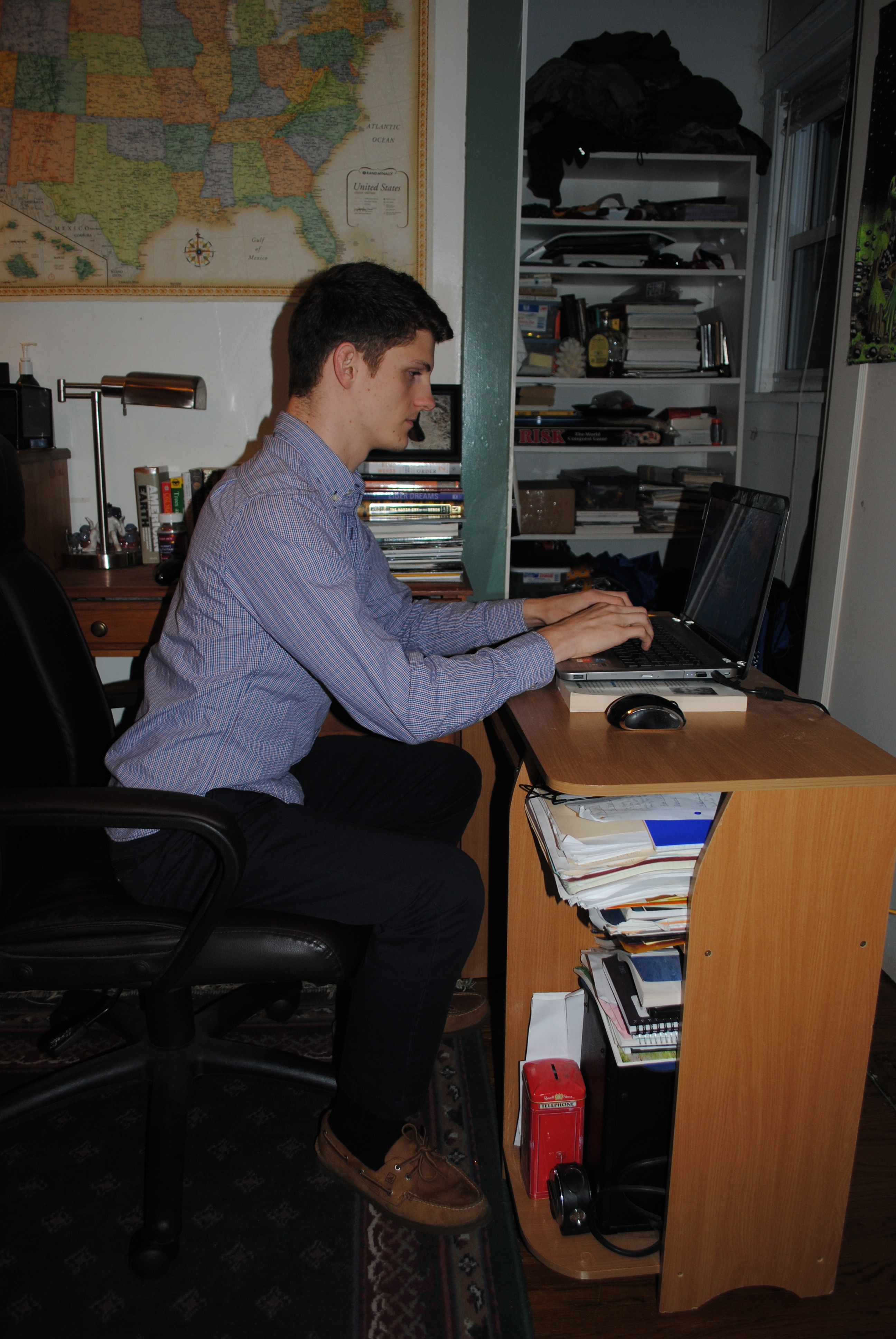
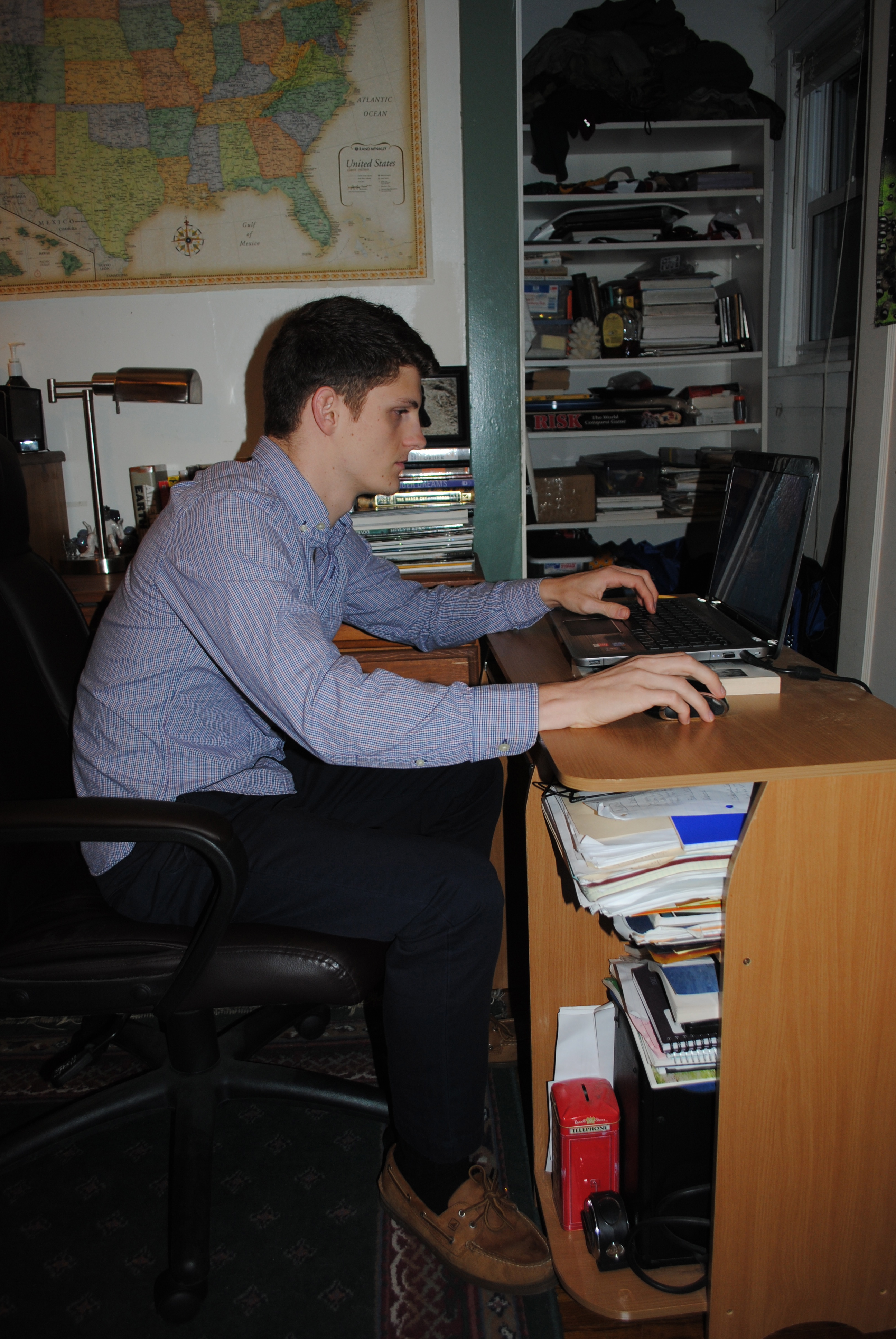
Well, I started observing my every movement and sure enough, I found the main culprit: my screen time with computer work and movie watching! First I noticed that I was leaning to the left on my elbow while at the computer. I was doing that because my desk is not designed for a laptop so there was no room for my mouse on the right unless the laptop was slightly pushed to the left. It had actually become so habitual, it felt very natural to lean on my left elbow. I actually caught myself doing it as I was watching a movie curled up with my elbow and forearm resting on the left side of the couch.

In that case, what can you do about it now?
Sure enough, logic had me make some ergonomic changes. I added a little folding table next to my desk on the right. This way, I could use my mouse from there while re-centering the laptop in front of me where the opening for my legs is. Then, I made a point to sit on the other side of the couch while watching a movie to avoid surrendering to my leaning to the left habit.

Things started getting better as I received some more hands-on work. Now the positive effect had more staying power. It took a few months to realize what was going on and a few more months to feel I had changed my habits sufficiently to feel almost back to normal. Spending more time at the computer to write a book had started this off or took what already was to another level!
DSC_0111DSC_0112DSC_0113

Are ergonomic changes enough?
Without making changes to my computer space I would now be in chronic pain,  feeling that nothing was helping. Although ergonomic changes helped break down the harmful habitual pattern, it was still not enough to heal fully. I needed to be aware of my postural reflexes (see blog #2). Triggering them re-centered me over and over thanks to the innate wisdom of the postural mechanism.

Changing a habitual way of moving by controlling the skeleton with muscle tension does not work. For instance, you use unnecessary muscle tension to hold yourself up and since it is neither comfortable nor natural, the next minute you collapse and think it is a lost cause! Sounds familiar?

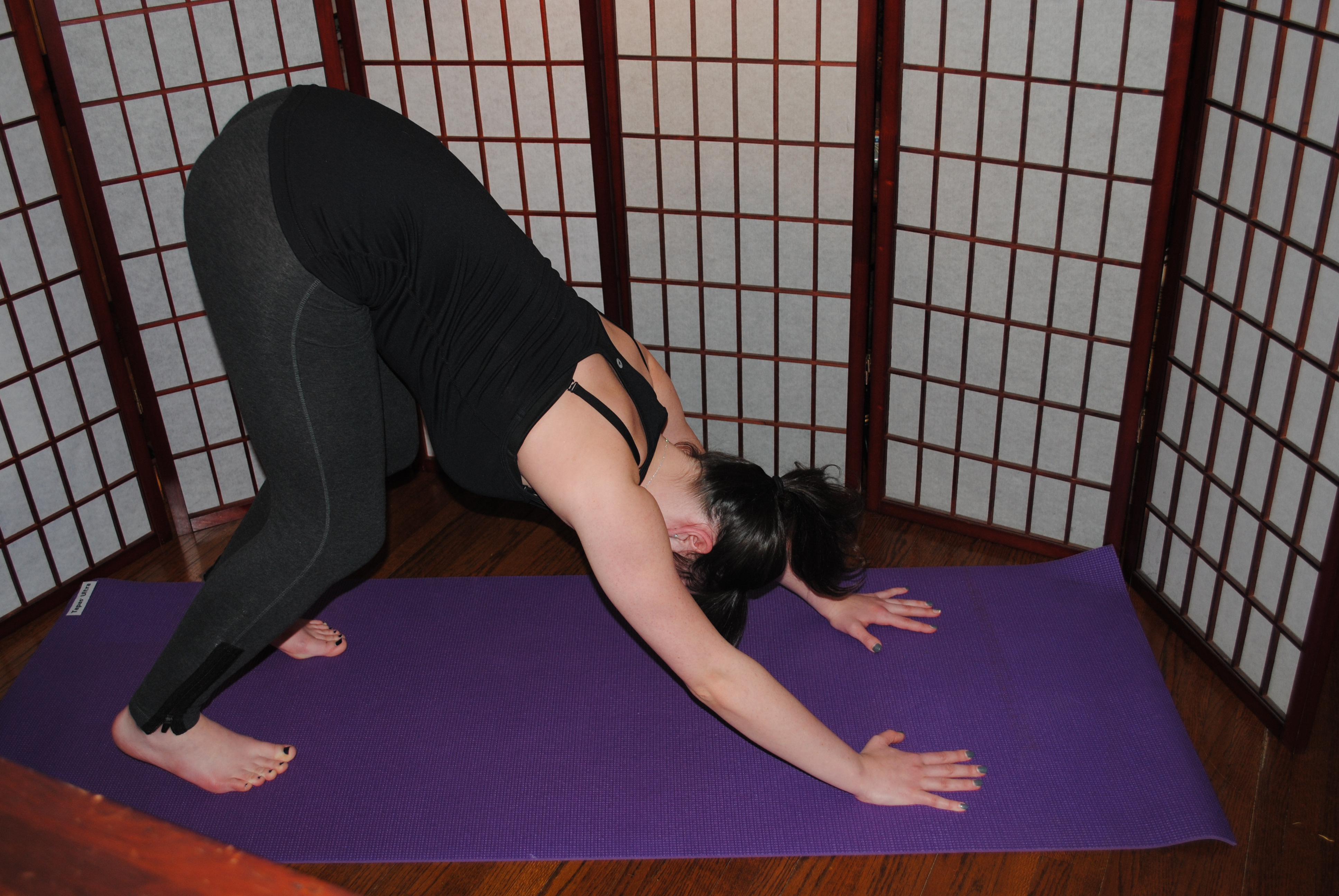
Awareness of your body and postural reflexes activation are an essential part to quality ergonomics. It does for you what good ergonomic equipment does for your work station. This is why, your awareness of the basic facts below can be quite helpful in preventing trouble or in moving away from discomfort or pain. Including the tips below into your yoga practice turns your yoga into a way to address computer related problems. The young lady below stopped doing yoga as it seemed to be hurting her back. Notice the improved alignment when she was taught how to activate her postural reflexes. Her hip joint socket released and suddenly her knees released and her head released at the top of the spine and she felt the increased ease within her pose!

DSC_0106DSC_0109

HELPFUL TIPS for both your Yoga & Computer Use
1) Always use the least amount of tension necessary while keeping your head, neck and torso aligned whether doing yoga or in front of a screen. Excess tension does not help building strength, it only builds up excess tension!

2) Know that your head, neck and torso won’t cooperate in staying open and up unless you are allowing your sits bones to point towards your seat away from your head. It is true whether you sit upright or lean forward towards your desk.

3) Releasing does not mean collapsing into yourself, it means letting go of excess tension all over your body without sacrificing your skeletal height. Releasing may feel like sand or water dripping down your skeleton into your support allowing your skeleton to expand in its full space almost like bread dough rising.

We function in two very basic ways: either we are in a state of contraction or we are in a state of expansion. So when we stop unnecessary tension to shrink our stature, the skeleton is ready to spring into expansion! And what a joy that is on or off the yoga mat!

Off The Mat Yoga and Smartphones!

Standard

Recently, I read a British article called “Do you suffer from IPosture” which you can read in the following link: http://www.dailymail.co.uk/health/article-2439365
It was found that 84% of 18 to 24-years-olds have admitted to suffering back pain in the last 12 months – perhaps because they were spending a large amount of time hunching over tablets and smartphones. Besides, this age group now loses more working days a year to back pain than those in their parents’ generation. Also, half of the population experience pain in the neck or lower back every year.

Are you in this age group? Do you go to the yoga class in the hope to get some relief?
Or do these issues actually keep you away from yoga?

Yoga is a good start for these neck and back pain because stretching tight muscles can be very helpful provided you do not force your stretch excessively. Of course, it also feels awfully good. The question is: what do you actually integrate from your yoga class and what is it you forget as soon as you leave the yoga studio? It seems to me that increased flexibility and strength are definitely yoga benefits that can drive you back to your class because you can feel the difference in your everyday life. However, could there be something missing in your practice? What could account for the difference in how aligned you look on the yoga mat and how it all melts away when you grab that smartphone or when you find yourself in front of a screen, be it the computer or the TV?

Can you give me a specific example?
Ok. For instance, when doing your eagle pose, your head neck and torso are aligned and your arms are bent at the elbows, hands pointing up. Then your class over, you go to the changing room and grab your smartphone to check your messages. Before you know it, do you find yourself with  your neck extended forward as your eyes face your smartphone which is itself parallel to the ground? Head neck and torso no longer are in alignment and the forward extension past your chest of both your neck and head are pulling your shoulders forward and down as well. Does that sound familiar? Look at the pictures below.

I PostureAligned ViewingI PhotoAligned Viewing

Why is alignment present on the mat and so difficult to remember off the mat?
First, you are mindful of your postural balance when in your yoga class in a way you are not outside of it. Still, you should not have to think about your postural balance all the time. So mindfulness is only part of the solution. The other part is to have a deeper understanding of movement, an understanding that includes the awareness of your postural reflexes and how to activate them. Without letting your postural reflexes do their job, you are using too much muscular tension to control your yoga pose. As a result, you cannot sustain it for very long. As a matter of fact, you are building unnecessary muscle tension while you are trying to build strength. That excess tension interferes with  your postural muscles strength build-up. Your postural muscles are in charge of your postural balance and can do so for long periods of time. When interfered with however, they can no longer do their job. They become lazy and make you surrender to gravity as in reading the smartphone after the yoga class.

 Helpful tips
As shown on the pictures above, you can start by bringing your yoga awareness to your everyday activities. For instance, next time you grab that smartphone to read your messages, don’t sacrifice your head neck and torso alignment. Use your eagle pose as a model of how to bring the phone in front of your face instead of binging your head and neck down to the phone. When possible and if you are planning to use your phone for a while, have your elbows supported so that you don’t have to hold your arms. You could use the back of a chair if it is tall enough for your height. You could sit and lean forward so your elbow rest on your thighs close to the knees or above them depending on your body type. Once you know what you do not want to sacrifice, you will figure something out that works in your environment. And till you learn to activate your postural reflexes so you can release and expand into your inner space, make sure you use the least amount of effort to do what you do. Release body excess tension into your support without sacrificing your head neck torso alignment. You will be ahead of the game!

Coming next: Off the Mat Yoga and working at the computer!

Part 2: What is Off The Mat Yoga?

Standard

What is Off the Mat Yoga?
Off The Mat Yoga was created to help you get the best out of your yoga practice, to prevent injuries and to help you feel good in your movements on and off the yoga mat. It is also to guide you in using your yoga poses as a guide in your everyday movements whenever possible. Through basic yoga poses and other daily movements, you will be guided both verbally and with a gentle touch to trigger your own postural reflexes. They are responsible for your best postural balance and ease of movement and can help you perform your best yoga yet! Check the blog on postural reflexes for more info about what these reflexes are and what they can do for  you.

On The Mat Yoga and Off The Mat Yoga are the two sides of the same coin. The way you understand and perform movements in your everyday life affects how you understand and perform yoga poses and movements. The reverse is true as well, the benefits of your yoga practice can help you handle life movements differently. You may have focused on getting more flexible or strong. You may have focused on learning the proper form. You may have focused on practicing being in the present moment and all these benefits of yoga are why people do go to yoga classes. However, many people still get hurt doing yoga, including some teachers. Many shy away from yoga from fear of getting hurt. And this does not have to be so! Many of you may have already experience moments of yoga or daily movements where everything seems to work together effortlessly, only you don’t necessarily know how you got there and how to get back to it instantaneously. Learning how to trigger your postural reflexes is the way to get to that place of perfect integration.

Yoga injuries and other types of injuries often happen because you have not been told how to activate your postural reflexes. Even when your teacher says “do what is right for you”; you only know how to control the degree of tension you use. Instead you can learn to let your postural reflexes do their job of reorganizing your whole body so unnecessary tension can be released on demand instantaneously. Learning about postural reflexes activation outside of the yoga mat helps you develop greater awareness of your ways of being and moving when you are off the mat. This way, you won’t bring harmful unconscious habits of movement to your yoga mat and you’ll feel better more of the time!

The truth is that your yoga class is likely to be overcrowded and your teacher has neither the time nor the skill to help you in this way. She is there to teach you the form as best she can. There is often a discrepancy between what she asks you to do and how you interpret it in your body; besides, the fact is that she is not trained in this primitive understanding of the body functioning nor is it her responsibility to teach you how to use your body in cooperation with your postural reflexes on and off the mat.

Coming soon: Off The Mat Yoga & Smartphones?

Part 1: What are postural reflexes?

Standard

What are postural reflexes? What do they do for you?
Postural reflexes are automatic movements that control the equilibrium required once you started walking and dealing with the gravity pull. They maintain your posture, balance and fluidity of movement effortlessly if there is no interference in the way.

What does that allow you to do while in your yoga class?
By activating your postural reflexes, it allows you to release through and expand into each pose in a way perfect to you in each moment. It also allows you to create modified versions of the poses you know not to attempt yet.

Don’t I do that when I try to be aware of my posture?
Not quite. There is posture and there is poise. Posture is something held, fixed and stopped in time that you can look at, like on a picture. However, poise is a sort of postural balance at work. And it is the job of the postural reflexes to maintain this postural balance as best as possible!

What is preventing my postural reflexes to do their job then?
Great question! Do you find yourself holding up into what you think is good posture and feel the urge to collapse in a flash if you let go of any holding?Did I hear you say “yes”? There is your answer; any amount of holding is preventing the postural muscles to do their job. No holding is necessary to be upright. We are so well designed in that way.

Have you ever thought that the unconscious way you handle movements in your everyday activities shows up in your yoga class? And could it be that although you do yourselves good when practicing yoga, yet you also strengthen unconscious habitual patterns that you take for granted everyday?

How can I learn not to do this holding and still be up?
Your golden key to all this is the ability to trigger your postural reflexes to stop overusing your muscles just to sit or stand upright! This way you can handle any activity or your daily yoga practice with confidence and know what is appropriate for you at any given moment. This way, you listen to yourselves rather than force your body to conform to a specific shape.

Coming soon “What is Off The Mat Yoga“?

Part 1: Why do you get hurt?

Standard

Why do you go to yoga in the first place?
You want to feel good and take care of your body and mind, right?

Yet, do you not wonder why you or others, sometimes even teachers get hurt doing yoga?
That is what I want to blog about because there is a common way to get injured that can be prevented.

When you get hurt on or off the mat, is it because you pushed yourself too hard? Is it because you are not flexible enough? Or perhaps you start your routine too fast? Or maybe you think your body gets hurt easily?
Yes
, partly sometimes , but not only! You get hurt because no one told you how your body really works on a deep primitive level. When you understand that, your yoga improves and it flows into your everyday life as it is intended.

I have done Kripalu Yoga, known to be gentle as well as Baptiste Yoga even though I am no boot camp fan. I like the sweating part to get toxins out of my system and also I like to challenge myself in movements I don’t do every day. My body is not your typical yoga class slender body and I had to overcome lots before I took up yoga. In fact, I started to learn about body movement and poise by becoming an Alexander Technique teacher and then I inched my way into yoga by becoming a Thai Yoga Therapist. Finally, I just went for it and by then I did not have to worry about hurting myself or embarrassing myself if I could not do a specific pose because I knew how to activate my postural reflexes. Also I knew that  I needed the yoga teacher to learn the form, yet I did not have to depend on her to teach me how to use my body to execute the form, and in a crowded class, it is a plus. Postural activation is your best friend everywhere you use your body!

More coming on Postural Reflexes!